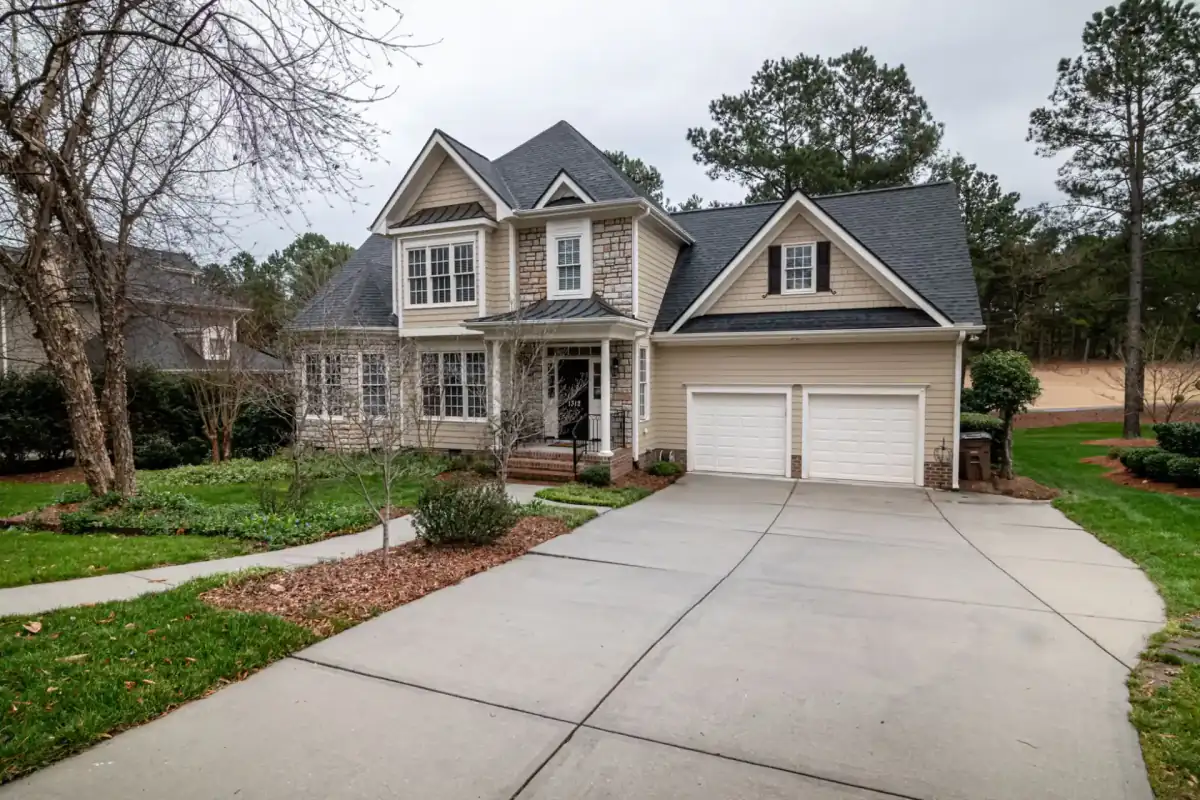
Concrete Driveways in Madison, WI — Residential & Commercial Driveway Specialists
New driveway pours, full replacements, extensions and reinforced slabs across Dane, Rock, Columbia and Jefferson Counties. Base and joint layout decided before anyone talks about a finish.
Concrete Driveways in Madison, WI
Madison Elite Concrete is your local resource for concrete driveways throughout Madison, Dane County and the surrounding area. We help homeowners connect with experienced concrete contractors who plan the base and the joint layout before the first truck is scheduled.
A concrete driveway in Madison is a four-inch compacted base problem before it is a concrete problem. The slab is five to six inches thick where vehicles park, four inches where they only cross, poured at 4,000 psi with air entrainment because ACI 318 treats exterior flatwork here as freeze-thaw exposure. None of that saves a driveway sitting on ground that was never compacted. On the newer subdivision lots around Sun Prairie and Verona, where the yard is backfilled clay that has not finished settling, the base work is most of the job.
The other half of a driveway is layout. Saw-cut control joints go in within the first day, a quarter of the slab depth, spaced in feet at roughly two to three times the slab thickness in inches. Those joints are a design decision — they should line up with the garage door jamb, the walk, and the edge of the approach, not land wherever the saw happened to start. Driveway approach and terrace work is a separate matter again: it sits in the public right-of-way, and the City of Madison requires contractors working there to be prequalified before a permit is issued. Requirements differ in Fitchburg, Middleton, Sun Prairie and Verona, so the scope gets confirmed at the estimate rather than assumed.
What’s Included in a Madison Concrete Driveways Quote
- On-site measurement of the drive, the approach, and the grade it has to hold — including where water currently goes and where it should go instead
- Removal and haul-away of the existing driveway when this is a replacement, with the subgrade inspected once it is exposed
- Subgrade preparation and compaction in lifts, then dense-graded base course to a depth set by the soil, not by a default
- Forming to the finished elevations, including the transition to the garage slab and to the approach
- Reinforcement specified for the use — #4 rebar on chairs where vehicles park or the ground is questionable, fiber mesh where it is not
- Air-entrained mix appropriate to Wisconsin freeze-thaw exposure, with the slump controlled at the truck
- Broom finish with the direction set to run water off the slab rather than along it
- Saw-cut control joints laid out to the door, the walk and the approach, cut within the first day at a quarter of slab depth
- Isolation joint where the driveway meets the garage slab, the apron or a foundation wall
- Cure-and-seal or a siloxane sealer as specified, plus written guidance on the first winter
- Site cleanup and removal of forms, stakes and spoil
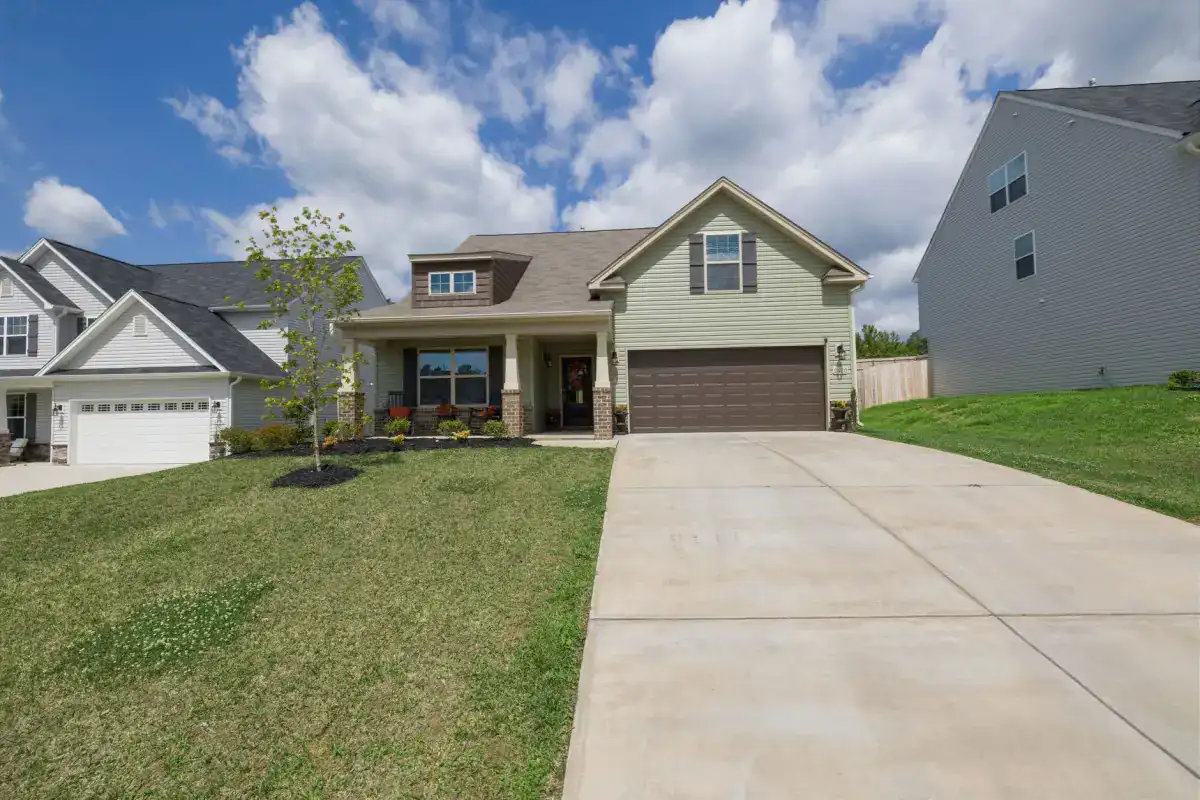
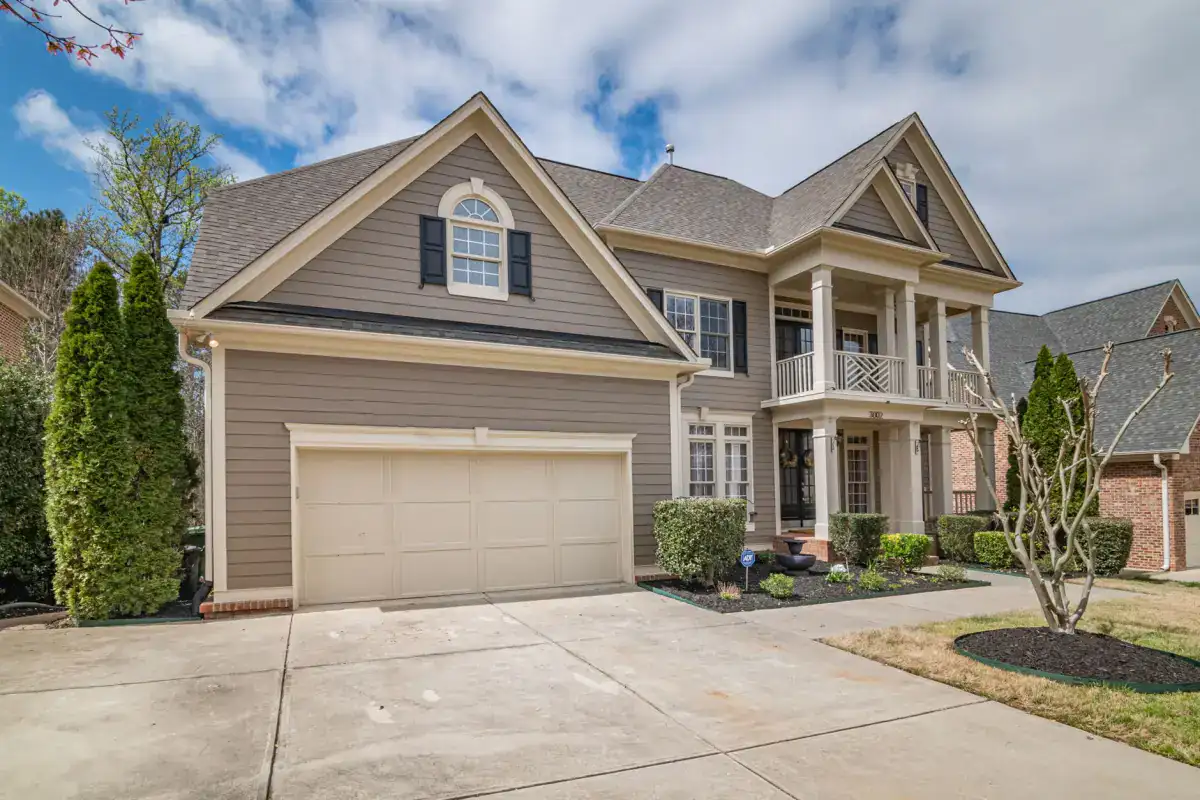
Concrete Driveway Installation in Madison, WI
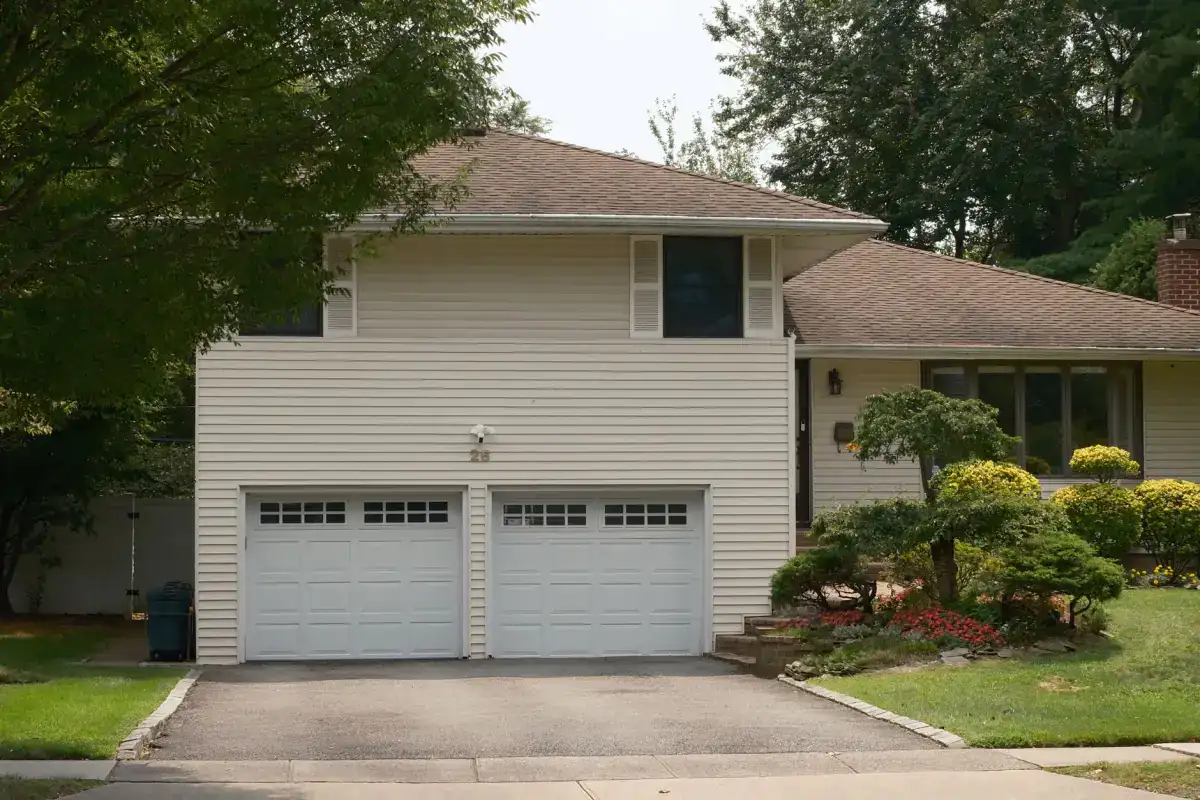
New Concrete Driveway Installation
A first driveway on a lot, or a concrete drive replacing gravel. This is the version where the base work is most visible in the final price, because there is no existing slab to tell you what the ground has been doing. The subgrade gets stripped of topsoil and organics, compacted in lifts, and brought up with dense-graded base course — four inches under residential flatwork as a starting point, deeper where the soil is soft or newly backfilled. Elevations get set against the garage slab, the walk, and wherever the drive meets the street. Width matters more than people expect: a single-car drive that has to accommodate two vehicles ends up with tire tracks off the edge, which undermines the slab from the side. Where the drive meets the public right-of-way, the approach is its own scope with its own permit requirements.
Concrete Driveway Replacement
Tear out the old drive, look at what is underneath, then pour. The looking is the part that matters. A driveway that cracked in a grid across the whole slab failed differently than one that broke along a single line, and one that settled at the apron failed differently again. Removal exposes the subgrade, and the answer is often visible immediately — a soft spot, a utility trench that was backfilled loose, a downspout that has been running under the slab for years. Replacing the concrete without fixing that gets you the same driveway again in eight years. Replacement is also the only honest answer for a slab with scaling across most of its surface, a structural crack running the full depth, or sections that have heaved out of plane with each other.
Concrete Driveway Extensions & Widening
Adding a parking pad, widening for a second vehicle, or extending toward a detached garage. The technical question is how the new concrete meets the old. A widening strip poured tight against an existing slab will move independently of it, so the joint between them is an isolation joint, not a control joint, and it needs to be detailed as one. Matching color is the part nobody warns homeowners about: new concrete cures lighter and stays visibly different from a twenty-year-old slab for a long time, and no amount of care at the pour changes that. Sometimes the honest recommendation is to replace the whole drive rather than end up with a permanent two-tone surface. On narrow isthmus lots off Willy Street where a widening is the only way to fit a second car, that trade-off is worth having out loud at the estimate.
Reinforced Concrete Driveways
Reinforcement does not stop concrete from cracking. It holds the crack together and keeps the two sides in the same plane, which is the difference between a hairline you stop noticing and an edge that catches a snow shovel. #4 rebar on chairs, tied in a grid and held at the correct height in the slab, is the specification where vehicles are heavy, where the subgrade is questionable, or where a drive spans a filled area. Fiber mesh does a different job — it controls plastic shrinkage cracking while the concrete is still curing — and it is not a substitute for bar where load is the concern. Rebar sitting on the ground because nobody used chairs does nothing at all, which is the most common way reinforcement gets paid for and not received. Thickening the edge of the slab is often worth more than adding steel to the middle.
Concrete Driveway Finishes & Design Options
A broom finish is the default for a driveway, and for good reason: it gives traction on a slope in February. The direction of the broom is a real decision, not a habit — it should run across the direction water travels, so the texture does not channel meltwater down the slab. Beyond broom, the realistic options are integral color mixed into the truck, exposed aggregate, a saw-cut pattern that turns the control joints into the design, or a border band in a contrasting color or finish. Stamped patterns are possible on a driveway and get their own treatment on the stamped concrete page, including how the stamp layout has to be reconciled with the joint layout. Whatever the finish, the sealer schedule is part of the decision: a sealed decorative drive needs resealing on an interval, and a slab that never gets resealed will not hold its color.
Concrete Driveway Repair vs. Replacement
Repair the Driveway
Worth it when the slab is structurally sound and the problem is localized — one cracked panel, a settled section that can be lifted, a spalled patch near the apron. Repair keeps the rest of the driveway's remaining life and costs a fraction of replacement. It is not worth it when you are repairing the third section in as many years.
Replace the Driveway
The answer when scaling covers most of the surface, when cracks run the full depth in several directions, when sections have heaved out of plane, or when the drive has already been repaired repeatedly. Replacement is also the only way to fix a base problem, because the base is under the slab. Expect the recommendation to come with the reason, and ask what was found under the old concrete.
Signs You Need Concrete Driveways
- Cracks wide enough to catch a shovel, or running the full depth of the slab rather than just the surface
- Sections sitting at different heights from each other — heaving, or settlement over a soft spot
- The surface flaking or peeling in sheets, which is scaling, usually from de-icing salt
- Standing water on the slab after rain, meaning the drive no longer holds its slope
- Pop-outs and crumbling along the edges, particularly at the apron where plows and salt concentrate
- A gravel drive you are tired of regrading, or a drive too narrow for the vehicles now parked on it
How Concrete Driveways Works
- 1
Site Visit, Measurement and Scope
The visit establishes three things: dimensions, elevations, and where water goes. Dimensions set the concrete volume and the forming. Elevations set the finished surface against fixed points that cannot move — the garage slab, the entry walk, the curb line at the street. Water is the one homeowners rarely raise and the one that decides whether the driveway lasts. A drive that pitches toward the garage, or toward a foundation wall, is a problem to solve at layout, not something to discover after the pour. This is also where the scope gets split. Work inside the property line is one job. Work on the driveway approach or across the terrace sits in the public right-of-way, where the City of Madison requires the contractor to be prequalified and a permit issued before anything is cut. Fitchburg, Middleton, Sun Prairie and Verona each handle this differently, so the estimate confirms which applies rather than assuming.
- 2
Removal, Subgrade and Base
On a replacement, the old slab comes out and gets hauled off, and then the subgrade is actually looked at. This is the most informative moment in the whole project. Loose backfill over a utility trench, a saturated soft spot, tree roots, or organics that were never stripped will all be visible, and any of them explains why the last driveway failed. Topsoil and organic material get removed because they compress and decay. What remains gets compacted in lifts rather than in one pass, since a compactor only densifies so many inches at a time. Dense-graded base course goes down on top, four inches as a residential starting point and deeper where the soil calls for it, compacted and graded to the finished slab elevations minus the slab thickness. Around Sun Prairie and Verona, where subdivision lots sit on backfilled clay that has not finished settling, this stage is where most of the real work happens.
- 3
Forming, Reinforcement and the Pour
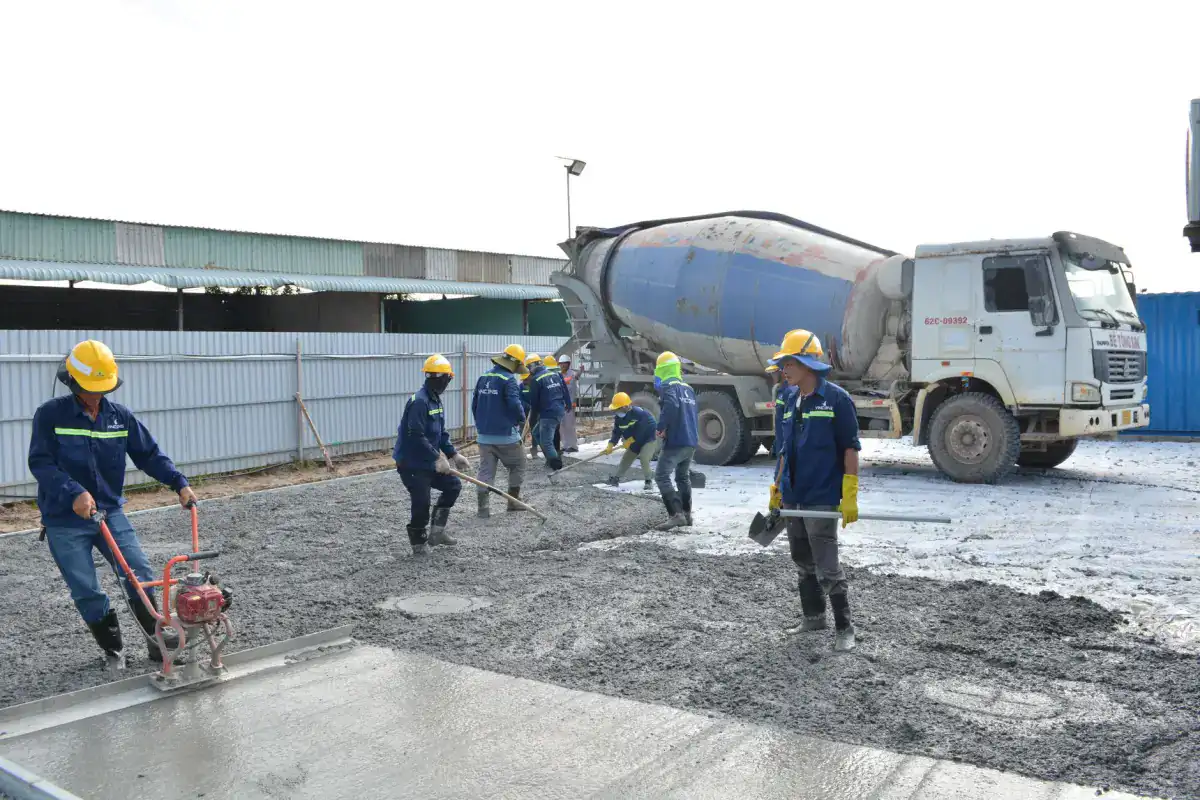
Forms get set to the elevations established at the site visit, braced to hold against the weight of wet concrete, and checked for the slope before anything arrives. Reinforcement goes in next — #4 rebar on chairs in a tied grid where vehicles park or the ground is questionable, fiber mesh in the mix where plastic shrinkage is the concern. Chairs matter: bar lying on the base is doing nothing. Isolation joint material goes wherever the slab meets something that moves independently, including the garage slab, the apron and any foundation wall. The mix for exterior flatwork here is 4,000 psi with air entrainment, which ACI 318 requires for freeze-thaw exposure, generally in the range of 4.5 to 7.5 percent air. Water added at the truck to make placing easier costs strength directly, which is why slump gets controlled rather than adjusted for convenience.
- 4
Finish, Joints and Cure
The concrete gets screeded to the forms, floated, and then left alone until the bleed water is gone — troweling a slab with water still on the surface is how scaling problems get built in on day one. Edges get tooled, then the broom finish goes on, with the direction chosen to shed water off the slab rather than channel it along. Saw-cut control joints follow within the first day, cut to a quarter of the slab depth, spaced in feet at about two to three times the slab thickness in inches, and laid out to line up with the garage door, the walk and the approach. Curing follows, then a cure-and-seal or siloxane sealer where specified. The last instruction is the one that protects everything above it: no de-icing salt the first winter. Most deicer manufacturers warn against use on concrete under a year old, and scaling on a new slab is usually a first-winter salt story.
What Do Concrete Driveways Cost in Madison, WI?
- Square footage, and how much of it is a simple rectangle versus curves, aprons and returns that slow the forming
- Removal and disposal of the existing driveway, which is priced by volume and by how easily a truck can reach it
- What the subgrade turns out to be — soft spots, loose trench backfill and organics all add base work that cannot be seen from the street
- Slab thickness and reinforcement: five to six inches with #4 rebar on chairs costs meaningfully more than four inches with fiber mesh
- Access. A narrow isthmus lot where no truck gets past the house means a line pump, and that is a real line item
- Whether the scope crosses into the public right-of-way, since approach and terrace work carries its own permitting and restoration requirements
- Finish: broom is the baseline, and integral color, exposed aggregate, borders or stamping each add cost and a sealer schedule
Pricing is set on site, because the two things that move a driveway estimate most are invisible until someone looks — what the subgrade is made of, and whether a truck can reach the pour. Be careful comparing quotes on square footage alone. A bid that is materially cheaper than the others is usually cheaper somewhere specific: thinner slab, less base, fiber mesh where the ground called for bar, or no allowance for the approach permit. Ask each estimate to state slab thickness, base depth, reinforcement type and joint spacing, and the numbers become comparable.
What to Look for in a Madison Concrete Driveway Contractor
The Base Gets Specified, Not Assumed
A good estimate tells you how deep the base is going and why. If the subgrade turns out worse than expected once the old slab is out, you should hear about it then — with the reason and the cost — rather than find out in three years.
Joint Layout Shown Before the Pour
Control joints are where the slab is told to crack. Skip that decision and the slab picks. A contractor who can point at the drive and say where the joints will run, and how they line up with the door and the walk, has thought about the finished surface.
Right-of-Way Scope Named Up Front
Driveway approach and terrace work sits on city property and carries prequalification and permit requirements that private work does not. That should be identified at the estimate, not discovered after the saw is running.
Written Guidance on the First Winter
New concrete and de-icing salt do not mix, and most deicer labels say so. A contractor who leaves you with the curing and first-winter instructions in writing is protecting the slab they just poured.
Residential & Commercial Concrete Driveways
Residential
Single and double drives, parking pads, extensions and full replacements on lots from Nakoma and Monroe Street to the newer subdivisions in Sun Prairie and Waunakee. Older near-west lots bring access constraints and tight elevations against existing walks; newer lots bring backfilled clay that has not settled. Both are solvable, and both change the estimate.
Commercial
Drive aisles, employee lots, service drives and delivery approaches for small commercial properties. The differences from residential are load, phasing and scheduling — the slab section is designed for the vehicles that will actually use it, and the work is sequenced so the property keeps a usable entrance while the pour cures.
When Concrete Driveways Isn’t the Right Call
- If your driveway has one cracked panel and the rest of the slab is sound, replacement is the wrong recommendation. Ask about replacing the single panel or repairing the crack, and keep the remaining life of everything else.
- If the ground under a new addition or a recently regraded yard is still settling, pouring a driveway over it now buys you a slab that will move with the soil. Wait, or budget for the base work it actually needs.
- If the damage is on the terrace sidewalk or the driveway approach and the city has already scheduled that section for repair, do not pay to have it replaced privately. Confirm with City Engineering first.
- If your property sits outside Dane, Rock, Columbia and Jefferson Counties, this is not the right resource. A local contractor closer to you will price the work better than someone travelling to reach it.
- If gravel genuinely suits the use — a long rural drive, a seasonal access lane, a farm approach — concrete is a large expense for a surface that gravel already handles.
Frequently Asked Questions
- How thick should a concrete driveway be in Wisconsin?
- Four inches is the common baseline for areas that only get crossed, and five to six inches where vehicles actually park or where anything heavier than a passenger car uses the drive. Thickness also drives joint spacing: control joints are spaced in feet at roughly two to three times the slab thickness in inches, so a thicker slab gets fewer joints. Where the subgrade is soft or newly backfilled, adding base depth is usually a better investment than adding an inch of concrete.
- Do I need a permit for a concrete driveway in Madison?
- It depends on where the work sits. Concrete entirely within your property line is a different matter from the driveway approach or the terrace, which are in the public right-of-way. The City of Madison requires contractors performing right-of-way work to be prequalified with the city, and a street terrace permit is issued through the Engineering Division for work including residential driveway aprons. Fitchburg, Middleton, Sun Prairie and Verona each set their own requirements. Confirm the scope at the estimate rather than after the saw is running.
- How long before I can drive on a new concrete driveway?
- The contractor doing the work sets the schedule based on the mix, the slab thickness and the weather during the cure, and it is longer than people expect — foot traffic well before vehicles, and full loads later still. Driving on a slab early does not always crack it visibly, but it can damage the surface and the edges. Get the specific timeline in writing before the crew leaves, because it varies with the pour.
- Why is my new driveway flaking and peeling?
- That is scaling, and on a new slab the usual cause is de-icing salt applied during the first winter. Most deicer manufacturers warn against use on concrete less than a year old. The other common causes are finishing the surface while bleed water was still on it, and adding water at the truck to make placing easier, which lowers strength directly. NRMCA's CIP 2 bulletin on scaling concrete surfaces covers the mechanism in two pages and is worth reading before the first snow.
- Can I widen my existing driveway instead of replacing it?
- Usually yes, and it is a common request on narrow older lots. Two things to plan for. The new strip moves independently of the old slab, so the seam between them is an isolation joint and needs to be detailed as one rather than saw-cut like a control joint. And the color will not match — new concrete cures lighter and stays visibly different from a twenty-year-old slab for years. If a uniform appearance matters to you, price full replacement alongside the widening before deciding.
- What is the best time of year to pour a driveway in Madison?
- Late spring through early fall gives the most predictable curing conditions. Pours are done outside that window with cold-weather or hot-weather measures, but both add cost and constraint. The more useful scheduling consideration is the first winter: a slab poured in October faces salt and freeze-thaw within weeks of curing, while one poured in May has a full season to gain strength first. If the timing is flexible, earlier in the season is the better slab.
Learn More
- NRMCA — CIP 2: Scaling Concrete Surfaces — The National Ready Mixed Concrete Association's two-page bulletin on why exterior slabs scale, and how finishing, air content and de-icing salt each contribute.
- City of Madison — Street Terrace Permit — The City Engineering Division's permit page covering residential driveway aprons and sidewalk replacement in the right-of-way, including the contractor prequalification requirement.
- City of Madison — Driveway Approach Standards — Traffic Engineering's breakdown of driveway approach classes and the standards that apply where a private drive meets a public street.
Need Concrete Driveways in Madison, WI?
Tell us what’s going on and get an on-site estimate — no charge for the visit, and no obligation to book the work.
Get My Free Estimate