Concrete Parking Lots in Madison, WI — Commercial Paving & Heavy-Duty Pavement Specialists
New concrete parking lots, replacement of failed sections, loading and delivery areas and heavy-duty pavement across Dane, Rock, Columbia and Jefferson Counties.
Concrete Parking Lots in Madison, WI
Madison Elite Concrete is your local resource for concrete parking lots throughout Madison, Dane County and the surrounding area. We help property owners and managers connect with qualified local concrete specialists for parking lot construction, replacement and heavy-duty pavement.
A concrete parking lot is a pavement, and it gets designed like one. Thickness comes from the vehicles that will actually use it — a car lot and a lot that takes daily semi deliveries are different pavements, and the difference is not marginal. Subgrade capacity, drainage and joint design carry as much weight as slab thickness. ACI's guidance for concrete parking lots caps joint spacing in unreinforced pavement at roughly 30 times the slab thickness and no more than 15 feet, which is the number that decides whether a lot cracks neatly along its joints or wanders.
The economics are different from asphalt in a way that is worth stating plainly, because it is the comparison every property owner makes. Concrete costs more up front. It lasts considerably longer, it does not rut or shove under standing truck loads, it does not soften in summer heat, and it needs less routine maintenance — no seal coating cycle. Asphalt is cheaper to install and faster to open to traffic. Which one is right depends on the traffic and how long the owner intends to hold the property, and any contractor who answers that question the same way every time is selling rather than advising. Where the lot connects to a city street, the approach sits in the public right-of-way and the City of Madison requires contractors working there to be prequalified.
What’s Included in a Madison Concrete Parking Lots Quote
- Review of the site, the traffic it carries, and any drawings, geotechnical report or civil design
- Traffic assessment covering vehicle types, delivery frequency and where heavy vehicles actually turn and stand
- A phasing plan showing which areas stay open and when, agreed before mobilization
- Drainage design review, including where water currently goes and where structures and inlets sit
- Removal and disposal of existing pavement where the scope is replacement, with recycling where available
- Subgrade preparation, compaction to the specified density, and proof rolling to find soft areas
- Base course to the specified depth and gradation, compacted and graded to the underside of the pavement
- Reinforcement and load transfer at joints where the design calls for it
- Air-entrained mix specified for freeze-thaw exposure and the design strength
- Joint layout designed to ACI spacing guidance and set out against the lot geometry and structures
- Curing, joint sealing, and coordination with striping, wheel stops, signage and bollards
Concrete Parking Lot Installation in Madison, WI
New Concrete Parking Lots
A lot built from scratch on a developed or newly graded site. The design work happens before any concrete is priced. Subgrade capacity determines what the pavement has to do; traffic determines the thickness, and it is usually not uniform — car parking bays, drive aisles and truck routes commonly get different sections rather than one thickness across the whole lot, since paying for a truck-rated pavement under parked cars is wasted money. Drainage is designed rather than inherited, with falls set to inlets and no low points that collect and freeze. Joint layout is drawn against the geometry: joints meeting inlets, aligning with bay lines and stopping at structures rather than running through them. ACI's guidance caps unreinforced joint spacing at about 30 times the slab thickness and 15 feet maximum.
Concrete Parking Lot Replacement
Replacing failed pavement, usually in sections and almost always on a site that stays in use. The first decision is scope, and on a lot it should be made from a condition assessment rather than a walk-around impression. Failures cluster: the drive aisle where trucks turn, the area in front of a dumpster, the low corner that holds water. Those sections often need a different pavement section than the rest of the lot, because they failed from being under-built for the load they actually carry, and rebuilding them to the original specification reproduces the failure. Removal exposes the subgrade and the drainage, which is where the explanation usually is. Phasing determines the price as much as the area does, because keeping a lot operational means multiple mobilizations.
Commercial Parking Areas
Employee lots, customer parking, overflow areas and multi-family resident parking. The design driver here is volume of passenger vehicles rather than heavy loads, which usually means a lighter pavement section than a truck route and a correspondingly lower cost per square foot. What matters most on these areas is drainage and surface condition, because they are walked across constantly. Water ponding in a parking bay becomes ice in front of a business, which is a liability rather than an inconvenience, and it is designed out with falls to inlets rather than fixed afterward. Layout coordination matters too: joints should relate to the striping and the bay lines, since joints running diagonally across parking stalls look like an afterthought and are noticed by everyone who parks there.
Concrete Loading & Delivery Areas
Dock aprons, delivery bays, trash and compactor pads, and the manoeuvring areas where trucks turn. This is where concrete has its clearest advantage over asphalt and where under-designing shows up fastest. A loaded trailer's landing gear concentrates enormous force on a very small footprint, and a parked trailer applies it for hours at a time, which is exactly the condition asphalt handles worst. Repeated turning movements from heavy vehicles apply shear at the surface that a pavement designed only for vertical load will not survive. These areas typically get increased thickness, load transfer at joints, and often reinforcement. Joint sealing matters here more than anywhere else on a site, because unsealed joint edges under repeated heavy wheel loads deteriorate quickly.
Heavy-Duty Concrete Pavement
Pavement designed for sustained heavy vehicle traffic: distribution yards, equipment storage areas, industrial site access, container and trailer parking. The design comes from an engineer working from real traffic data — vehicle types, axle loads and repetitions — rather than from a thickness that sounds adequate. Subgrade preparation carries more weight in heavy-duty design than almost anything else, because a pavement is only as good as what supports it, and soft areas that are tolerable under car traffic fail quickly under repeated heavy loads. Load transfer across joints is generally essential, since without it each panel deflects independently as a heavy wheel crosses and the joint edges break down. Drainage is critical as well: water in the subgrade under a heavily loaded pavement accelerates failure substantially.
Concrete vs. Asphalt for a Commercial Parking Lot
Concrete Parking Lot
Higher installation cost, considerably longer service life. Does not rut or shove under standing trailer loads, does not soften in summer heat, needs no seal coating cycle, and reflects light so lots need less lighting. Repairs are more visible and section replacement is more involved. Generally the better economics on a property held long term or carrying heavy vehicles.
Asphalt Parking Lot
Lower installation cost and faster to open to traffic. Flexible, so it tolerates minor subgrade movement without cracking, and surface repairs blend more easily. It requires periodic seal coating and crack filling, ruts under standing heavy loads, and softens in summer heat. Often the right answer for car-only lots or shorter holding periods.
Signs You Need Concrete Parking Lots
- Rutting, shoving or depressions where trucks stand or turn, which asphalt does under sustained heavy loads
- Water ponding in bays or aisles, becoming an ice hazard every winter in front of a business
- Cracking with vertical displacement between sections, indicating loss of subgrade support
- Potholes and repairs recurring in the same areas year after year
- A dock apron or delivery area deteriorating faster than the rest of the lot
- A new development, expansion or change of use bringing heavier vehicles onto pavement not designed for them
How Concrete Parking Lots Works
- 1
Traffic Assessment, Design Review and Phasing
The pavement is designed around what actually drives on it, so the first task is establishing that honestly — vehicle types, how often deliveries arrive, where trucks turn and where trailers stand. Those points concentrate load and frequently justify a heavier section than the rest of the lot. A geotechnical report, where one exists, sets what the subgrade provides; where none exists on a significant project, obtaining one is usually cheaper than the pavement failure it prevents. Drainage is reviewed against the existing site, since a lot that ponds today will pond after repaving unless falls and inlets are corrected. Then the phasing plan, which on an operating property drives both cost and duration: which areas stay open, how customers and deliveries are routed, and whether any work needs to happen outside business hours.
- 2
Demolition, Subgrade and Base
Existing pavement is saw-cut at clean boundaries and removed, with material taken for recycling where a facility is available — asphalt and clean concrete both have established recycling routes and the volumes on a lot are substantial. Removal exposes the subgrade, and on a replacement this is where the failure explains itself: saturated ground with no drainage path, fill that was never compacted, or a section simply built lighter than the traffic it ended up carrying. Subgrade is prepared and compacted to the specified density, then proof rolled, which is how soft areas are found before pavement is placed over them. Soft areas are excavated and replaced with engineered fill. Base course is placed to the specified depth and gradation, compacted, and graded accurately to the underside of the pavement.
- 3
Forming, Reinforcement, Load Transfer and Joint Layout
Forms are set to the design elevations with drainage falls built in and verified, because a lot that ponds is a liability every winter and correcting it afterward means removing pavement. Reinforcement goes in where the design calls for it, supported on chairs at the correct depth. Load transfer devices — dowels or plates — are placed at joints on any pavement carrying heavy vehicles, aligned properly, since a misaligned dowel restrains the joint rather than transferring load across it and causes the cracking it was meant to prevent. The joint layout is set out to the plan: spacing within ACI's guidance of about 30 times the slab thickness and 15 feet maximum for unreinforced pavement, with joints meeting inlets and structures, aligning to bay lines, and isolating around light pole bases, bollards and manholes.
- 4
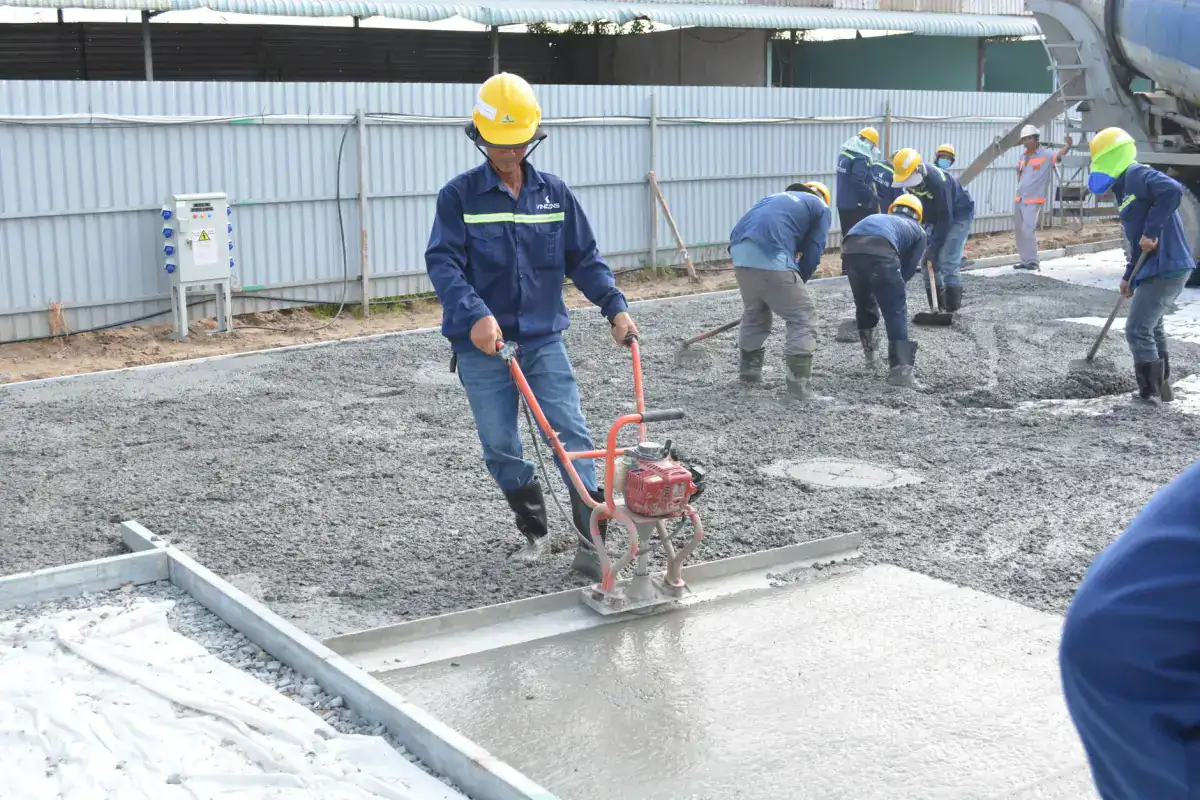
Placement, Finishing, Curing and Sealing
Concrete is placed to the specified mix — air-entrained, because a parking lot in Wisconsin is fully exposed to freeze-thaw cycling and takes de-icing chemicals every winter. It is consolidated, screeded to the formed grade, and finished with a broom texture for traction. Saw cutting follows on schedule to the agreed joint plan and at the specified depth; timing is critical, and a joint cut late is a joint the pavement has already cracked past. Curing follows the specification. Joints are then sealed, which on a parking lot is genuinely important rather than optional: sealed joints keep water and de-icing brine out of the base, and the base is what the pavement depends on. Striping, wheel stops, signage and bollards are coordinated once the concrete has gained sufficient strength.
What Do Concrete Parking Lots Cost in Madison, WI?
- Pavement thickness and reinforcement, which come from the design traffic rather than a uniform assumption
- Total area, and whether the design uses different sections for car bays, drive aisles and truck routes
- Subgrade conditions, including over-excavation and engineered fill where proof rolling finds soft areas
- Removal and disposal of existing pavement, offset where asphalt or clean concrete can go for recycling
- Drainage work — new or relocated inlets, regrading, and correcting existing low points
- Phasing to keep the property operating, since staged work means multiple mobilizations
- Out-of-hours or weekend scheduling, traffic control and pedestrian protection on an occupied site
- Load transfer devices, joint sealing, striping, wheel stops, bollards and light pole base coordination
Concrete costs more than asphalt to install and generally less to own over a long holding period, which is why the useful comparison is lifecycle rather than installed price — asphalt carries a recurring seal coating and crack filling cycle that concrete does not. Where quotes for the same concrete lot differ substantially, the reasons are usually pavement section, subgrade provision and phasing. Ask each proposal to state the thickness for each area, whether load transfer is included at joints, what happens if proof rolling finds soft subgrade, and how many mobilizations the phasing assumes.
What to Look for in a Madison Concrete Parking Lot Contractor
A Pavement Section That Varies With Use
Car bays, drive aisles and truck routes carry different loads. A single thickness across the whole lot is either over-paying under parked cars or under-building where trucks turn. Ask how the section varies.
Drainage Designed, Not Inherited
A lot that ponds today will pond after repaving unless the falls and inlets are corrected. Standing water in front of a business becomes ice, and that is a liability rather than a maintenance item.
Joint Spacing to ACI Guidance
About 30 times the slab thickness and no more than 15 feet on unreinforced pavement. Spacing beyond that is how a lot ends up cracking between the joints rather than along them.
Phasing Priced, Not Improvised
Keeping a property operational means staged work and multiple mobilizations, and that has a real cost. It belongs in the proposal alongside a plan for access and pedestrian routing, not as a conversation on day one.
Residential & Commercial Concrete Parking Lots
Residential
Multi-family and condominium properties fall into this scope — resident parking, visitor bays, drive aisles and refuse collection areas — where the pavement design is commercial but residents are on site continuously, which makes phasing and access the governing constraint rather than the concrete.
Commercial
Retail, office, industrial and institutional properties across Dane County and the surrounding counties, from customer lots and employee parking through to dock aprons, truck manoeuvring areas and heavy-duty yard pavement.
When Concrete Parking Lots Isn’t the Right Call
- If the lot carries only passenger vehicles and the property is being held short term, asphalt may be the better financial answer. A contractor who will say that rather than quoting concrete regardless is worth listening to.
- If the failures are confined to specific areas — the truck turn, the dumpster pad, one low corner — replacing the whole lot is more scope than the problem needs. Ask for a prioritised, sectional approach instead.
- If the underlying issue is drainage, repaving without correcting it reproduces the failure on a delay. That drainage work may sit outside a paving scope and needs to be resolved first.
- If the traffic and subgrade have not been assessed on a significant project, get that done before pricing pavement. A geotechnical report costs less than the failure it prevents.
- If the property is outside Dane, Rock, Columbia and Jefferson Counties, a contractor closer to you will mobilize more efficiently, which matters on staged work.
Frequently Asked Questions
- Is a concrete parking lot better than asphalt?
- It depends on the traffic and the holding period, and any contractor who gives the same answer every time is selling rather than advising. Concrete costs more to install and lasts considerably longer, does not rut or shove under standing trailer loads, does not soften in summer heat, and needs no seal coating cycle. Asphalt is cheaper up front, faster to open, and tolerates minor subgrade movement without cracking. For a car-only lot on a property held for a few years, asphalt often wins. For heavy vehicles or a long hold, concrete generally does.
- How thick should a concrete parking lot be?
- It varies by area, and a well-designed lot does not use one thickness throughout. The section comes from the design traffic — vehicle types, axle loads and how often they repeat — combined with what the subgrade can support. Car parking bays typically need a lighter section than drive aisles, and both need less than an area where loaded trucks turn or trailers stand. ACI publishes guidance for the design and construction of concrete parking lots covering thickness determination, and on any significant lot that design should be done rather than estimated.
- How far apart should joints be in a concrete parking lot?
- ACI's guidance for unreinforced parking lot pavement puts maximum spacing at about 30 times the slab thickness, and no more than 15 feet regardless. So a six-inch pavement can go to roughly 15 feet, while a thinner section needs closer spacing. Layout matters alongside spacing: joints should meet inlets and structures, align with bay lines, and isolate around light pole bases, bollards and manholes rather than running through them. Joints spaced beyond the guidance is a common reason lots crack between the joints rather than along them.
- Can our parking lot be replaced without closing the business?
- Almost always, through phasing, and that plan belongs in the proposal. Typical approaches are working one section or drive aisle at a time, keeping an entrance and a route to the door open throughout, and scheduling pours over a weekend or outside business hours where the site is tight. Each adds cost, because phasing means multiple mobilizations. For most businesses that premium is smaller than the revenue lost by closing, but it should be an explicit comparison rather than an assumption.
- How long does a concrete parking lot last?
- Considerably longer than asphalt when it is designed for the traffic it carries, built on properly prepared subgrade, jointed correctly and sealed. The variables that shorten it are all avoidable at design stage: a pavement section too light for the vehicles, poor subgrade preparation, joint spacing beyond guidance, and water in the base because drainage was never corrected. De-icing chemicals matter too — a lot is fully exposed to them every winter, which is why the mix has to be air-entrained and why joint sealing keeps brine out of the base.
- Do we need a permit for parking lot work in Madison?
- Work inside the property boundary may or may not require its own permit depending on the scope and whether drainage or site changes are involved, and larger site work generally does. The part that is consistent is the connection to the street: a driveway approach sits in the public right-of-way, and the City of Madison requires contractors performing right-of-way work to be prequalified before a permit is issued. Fitchburg, Middleton, Sun Prairie and Verona each set their own requirements, so confirm for the specific address.
Learn More
- ACI PRC-330 — Commercial Concrete Parking Lots and Site Paving — The American Concrete Institute's guide to parking lot design and construction, covering site investigation, thickness determination, joint design and durability.
- City of Madison — Engineering Permits — Permits required for work in the public right-of-way, including where a commercial driveway approach connects a private lot to a city street.
- FHWA — Air Entrainment and Concrete Durability — Why entrained air is essential in pavement exposed to freeze-thaw cycling and de-icing chemicals, which describes every parking lot in this region.
Need Concrete Parking Lots in Madison, WI?
Tell us what’s going on and get an on-site estimate — no charge for the visit, and no obligation to book the work.
Get My Free Estimate