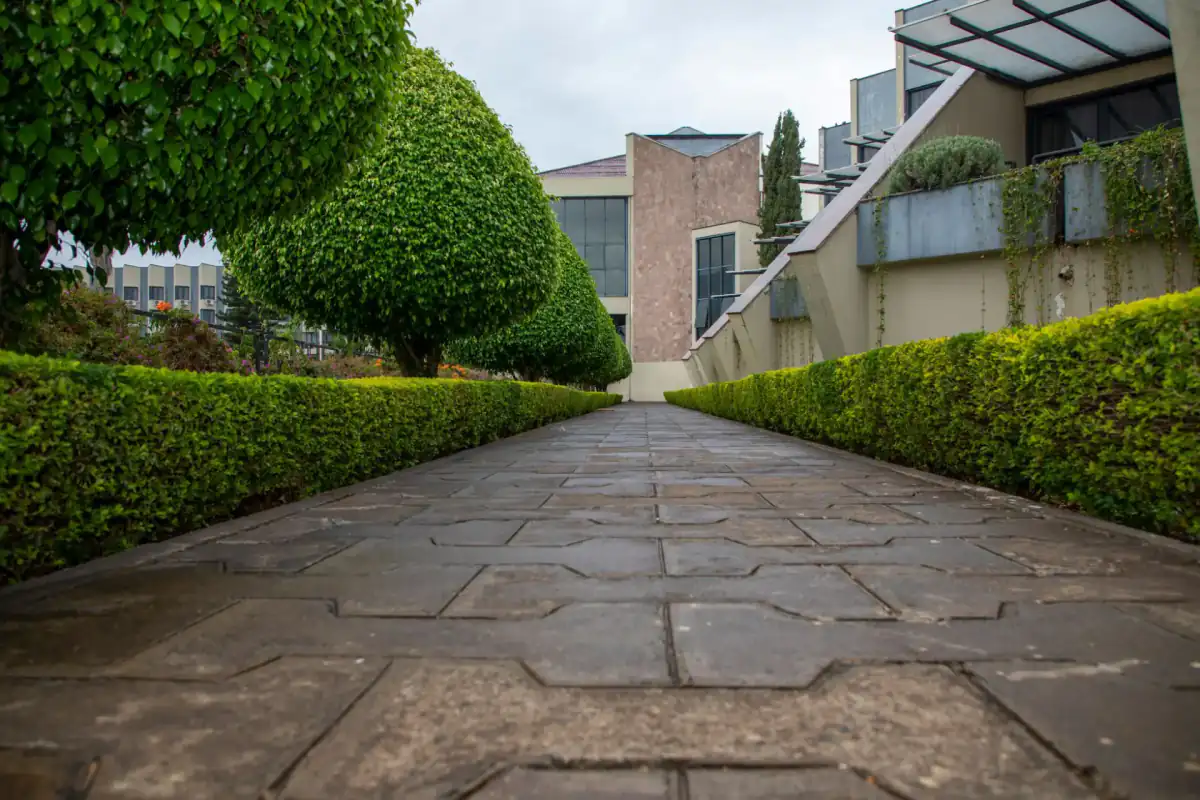
Stamped Concrete in Madison, WI — Residential & Commercial Decorative Concrete Specialists
Stamped patios, driveways and walkways across Dane, Rock, Columbia and Jefferson Counties. Joint layout planned against the stamp pattern before the pour, not after.
Stamped Concrete in Madison, WI
Madison Elite Concrete is your local resource for stamped concrete throughout Madison, Dane County and the surrounding area. We help homeowners connect with trusted decorative concrete finishers who plan the joint layout against the stamp pattern before the truck is scheduled.
Stamped concrete is a normal slab with a pattern pressed into it while it is still plastic, colored either integrally in the truck or at the surface with color hardener and release powder. Everything that makes an ordinary slab last still applies — compacted base, air-entrained mix for freeze-thaw exposure, control joints, a sealer on a real interval. Stamping adds a timing problem on top of all that. The surface has to be worked in a window that opens and closes with the weather, so a crew that is a person short, or a truck that arrives forty minutes late, shows up permanently in the finished slab.
The detail that separates good stamped work from the rest is the joint layout. A slab still needs saw-cut control joints, and on stamped concrete those joints run straight through a pattern that is pretending to be individual stones. If the layout is planned first, the cuts follow a grout line and disappear. If it is not, a straight saw cut runs across the middle of a fake flagstone and the whole illusion collapses. Stamped concrete looks like flagstone right up until the joint layout lines up with nothing. Then it looks like stamped concrete. Pattern choice matters here too, and a catalog photographed in Arizona is not the best guide for a Nakoma backyard that spends four months under snow.
What’s Included in a Madison Stamped Concrete Quote
- Pattern and color selection reviewed on site, in daylight, against the house and any existing hardscape
- A joint layout planned against the chosen pattern before the pour, so the saw cuts follow the pattern rather than crossing it
- Excavation, subgrade compaction in lifts, and dense-graded base course to a depth set by the soil
- Forming to the finished elevations and slope, with the slope confirmed before concrete is ordered
- Fiber mesh or #4 rebar on chairs, specified for the slab size and what the ground is doing
- Air-entrained mix appropriate to Wisconsin freeze-thaw exposure, with slump controlled at the truck
- Integral color in the truck, or color hardener and release powder worked at the surface, as specified
- Stamping with the mats and touch-up tools needed to detail edges, corners and the perimeter
- Release powder washed off and the surface cleaned once the slab has cured enough to take it
- Saw-cut control joints at a quarter of slab depth, cut to the planned layout within the first day
- Sealer applied at the correct rate, with the resealing interval stated in writing
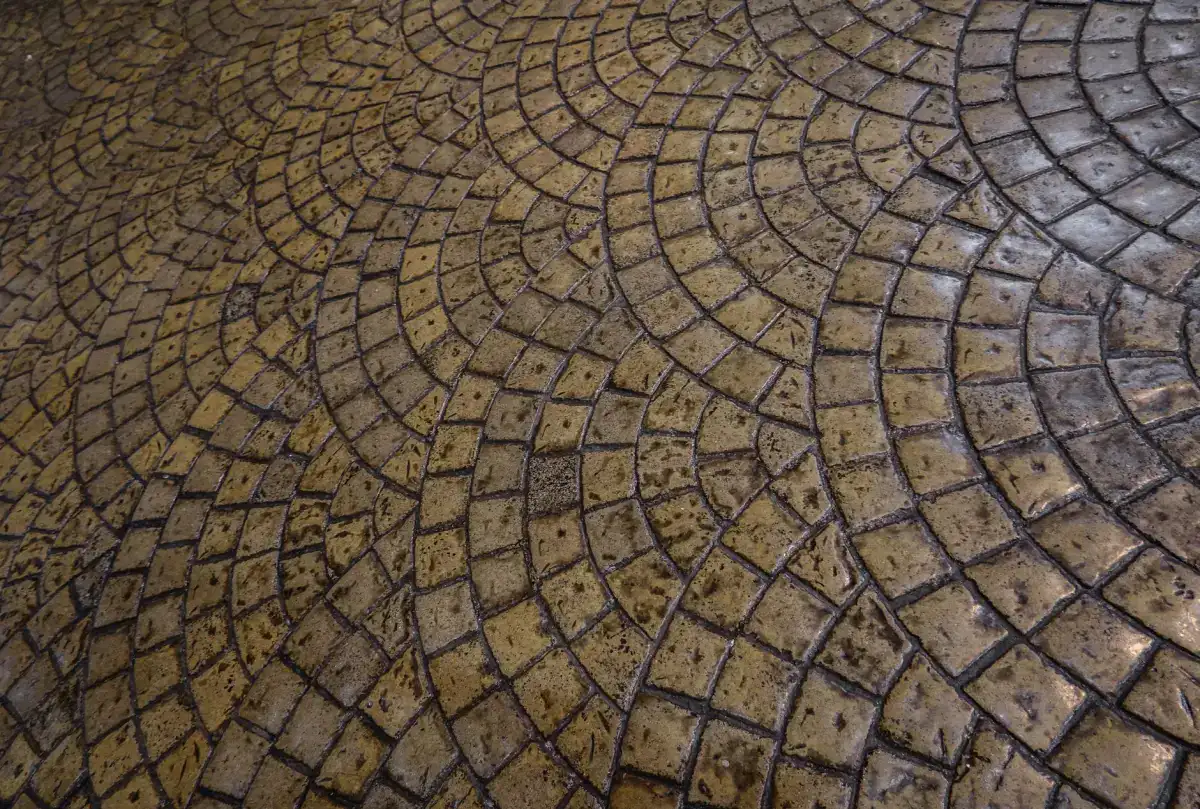
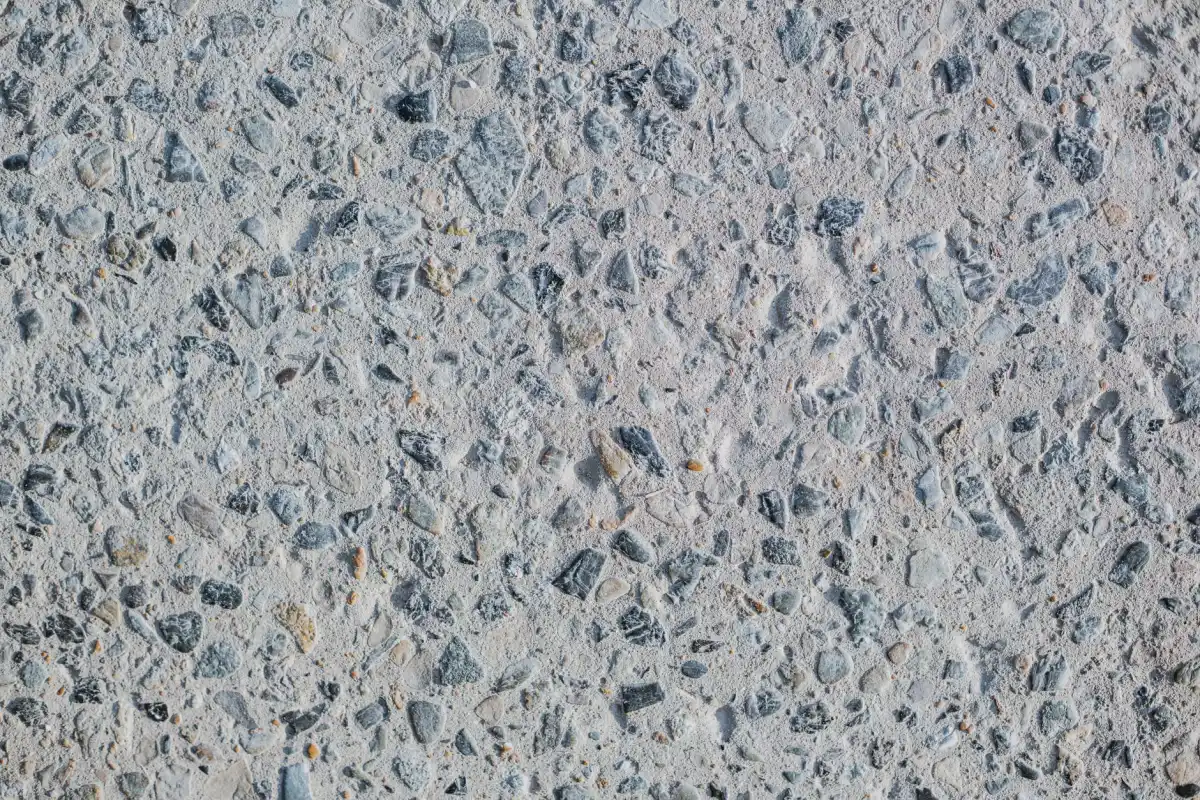
Stamped Concrete Installation in Madison, WI
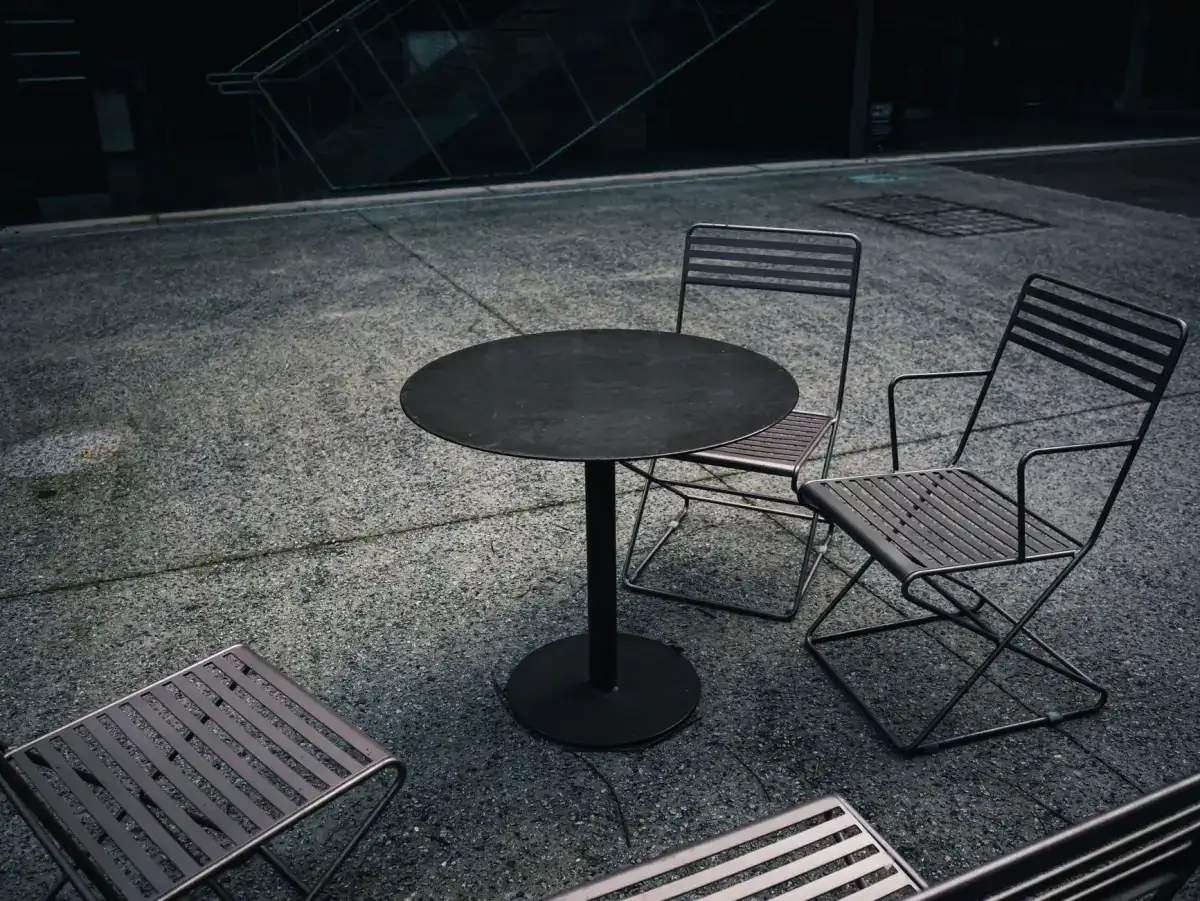
Stamped Concrete Patios
The most common stamped application, and the one where the pattern is looked at most closely, because people sit on a patio rather than drive over it. Scale is the decision homeowners underestimate. A large-format ashlar slate pattern reads well on a big open slab and looks wrong on a small patio, where the repeat becomes obvious in a way it is not at scale. On a modest backyard slab, a smaller random stone or a running bond pattern usually holds up better. Traction is the other consideration people raise late: a heavily textured stamp is grippier underfoot than a smooth one, and the sealer choice affects that more than the pattern does. A patio sealed too heavily turns slick in the rain, which is a maintenance decision more than a design one.
Stamped Concrete Driveways
Stamping a driveway works, with two adjustments. The slab is thicker and more heavily reinforced than a patio — five to six inches where vehicles park, usually with #4 rebar on chairs — which changes the joint spacing, since control joints are spaced in feet at roughly two to three times the slab thickness in inches. That wider spacing has to be reconciled with the stamp pattern, and it is easier to do at layout than after the fact. The bigger consideration in Madison is winter. A driveway is the surface most exposed to de-icing salt, plow blades and freeze-thaw cycling, and colored stamped work shows wear faster than plain grey. Expect a shorter resealing interval on a stamped drive than on a stamped patio, and expect the first winter rule — no salt on new concrete — to matter more here than anywhere else on the property.
Stamped Concrete Walkways
Walks and front paths are narrow, which makes the pattern scale question sharper than it is on a patio. A three-foot-wide walk running a large stone pattern shows perhaps one and a half stones across its width, and the pattern reads as cut-off rather than continuous. Smaller patterns, running bond brick, or a stamped border with a plain field usually work better at that width. A front walk in a neighbourhood like Nakoma or Shorewood Hills also has to make sense against the house and against the neighbouring properties, which is worth looking at in daylight rather than from a sample board. Where a walk continues across the terrace to the street, that section is in the public right-of-way and carries its own permit requirements and standards — the decorative scope usually stops at the property line.
Stamped Concrete Patterns & Textures
The patterns that get specified most often here are ashlar slate, random stone, cobblestone and wood plank. Ashlar slate is a rectangular, tile-like layout that reads as formal and works well on large open slabs. Random stone is irregular and hides small imperfections and repeats better, which makes it forgiving on complicated shapes. Cobblestone gives a smaller repeat that suits narrow walks and borders. Wood plank is the most demanding of the four, because the grain direction has to be planned across the whole slab and a misaligned plank is obvious. Texture — as opposed to pattern — is a separate choice: a light seamless skin texture gives a stone-like surface with no repeating shapes at all, which is the best answer where the joint layout cannot be made to disappear.
Colored & Decorative Stamped Concrete
Two coloring methods, and they behave differently over time. Integral color is mixed into the truck, so the color runs through the full slab depth and a chip does not expose grey underneath. It is more muted, and the whole load has to be right because it cannot be adjusted at the surface. Color hardener is broadcast onto the surface and worked in, producing a denser, harder, more saturated finish, but the color lives in the top layer and deep damage shows. Release powder, used to keep the stamp mats from sticking, is also a secondary color that settles into the low points of the pattern and gives it depth. Most stamped work uses a base color and a release in a related tone. All of it depends on sealer: the color holds exactly as long as the sealer does, so the resealing interval belongs in the conversation on day one.
Stamped Concrete vs. Pavers in a Freeze-Thaw Climate
Stamped Concrete
One continuous slab, so there are no unit joints to weed or re-sand, and the cost per square foot is generally lower than natural stone or pavers. It needs resealing on an interval to hold color, it will crack somewhere — that is what the joints are for — and repairs are difficult to make invisible because matching aged color is close to impossible.
Pavers
Individual units that flex with freeze-thaw movement instead of cracking, and single pavers can be lifted and reset if something settles. Color goes through the unit and does not need sealing to survive. It costs more per square foot, the joints need sand and occasional weeding, and edge restraint is what keeps the field from spreading over the years.
Signs You Need Stamped Concrete
- You want the look of flagstone, slate or cobblestone without the per-unit cost of natural stone
- An existing plain slab is sound and draining well, but visually dated against a renovated house
- You are already replacing a patio, driveway or walk, and the incremental cost of stamping is worth pricing
- A large expanse of plain grey concrete needs breaking up with borders, bands or a change of texture
- Existing stamped work has lost its color and gone chalky, which is usually a sealer question rather than a concrete one
- You want a continuous surface with no unit joints to weed, re-sand or reset
How Stamped Concrete Works
- 1
Pattern, Color and Joint Layout
This stage decides whether the finished slab reads as stone or as stamped concrete, and it happens before any excavation. Pattern gets chosen against the actual scale of the slab, not from a catalog photo — a large-format pattern on a small patio shows its repeat, and a wide pattern on a narrow walk reads as cut off. Color gets looked at outdoors, in daylight, against the house and any existing hardscape, because a sample viewed indoors is misleading. Then the joint layout gets drawn. The slab still needs saw-cut control joints, and on stamped work those cuts have to be planned to follow a grout line in the pattern rather than crossing the middle of a stone. Getting this right costs nothing at the planning stage and cannot be fixed afterward. Where the slab has to meet an existing patio, walk or step, those transitions get resolved here too.
- 2
Excavation, Base and Forming
Everything under a stamped slab is the same as under a plain one, and it matters just as much — the decorative surface does nothing for the structure. Sod, topsoil and organics get stripped completely, since organic material compresses and decays and produces uneven settlement within a few seasons. The subgrade gets compacted in lifts, then dense-graded base course goes down to a depth set by what the soil turns out to be. Forms are set to the finished elevations and to the drainage slope, around an eighth of an inch per foot away from the house on a patio, verified along every edge before concrete is ordered. Isolation joint material goes wherever the slab meets the house, a stoop, a foundation wall or existing concrete. Reinforcement follows the use: fiber mesh on a typical patio, #4 rebar on chairs on a driveway or where the ground is questionable.
- 3
Pour, Color and Stamping
This is the stage with no margin. The concrete is placed, screeded and floated, and if integral color was specified it arrived already mixed in the truck. If color hardener is being used instead, it gets broadcast onto the floated surface and worked in, usually in two applications. Then everyone waits for the slab to reach the right stiffness — firm enough to hold an impression, soft enough to take one — and that window moves with air temperature, humidity, sun and wind. Release powder goes down so the mats do not stick and to settle color into the low points of the pattern. The mats are placed in sequence, tamped, lifted and advanced across the slab, with hand tools used to detail edges, corners and anywhere a mat cannot reach. A crew that is short-handed, or a slab that sets faster than expected, produces inconsistent depth of impression, and that is permanent.
- 4
Cutting, Washing, Curing and Sealing
Saw-cut control joints go in within the first day, to about a quarter of the slab depth, following the layout planned at the start so the cuts land in grout lines rather than across stones. Once the slab has cured enough to take it, the residual release powder gets washed off — leaving too much makes the surface muddy, taking off too much strips the secondary color out of the pattern, and finding the middle is a judgement call. Curing continues, then the sealer goes on at the manufacturer's rate. Rate matters more than brand: sealer applied too thickly leaves a patio that turns slick in the rain and can cloud or blush later. The resealing interval gets handed over in writing along with the first-winter instruction, which on stamped work is not negotiable — no de-icing salt on new concrete, and as little as possible on colored concrete ever.
What Does Stamped Concrete Cost in Madison, WI?
- Square footage, and how much of the perimeter is curved, since stamping curves and edges takes hand detailing
- Pattern complexity — a seamless texture is quicker than a large-format ashlar layout with planned grout lines
- Coloring method: integral color, color hardener with release, or both, each priced differently
- Whether this is new work or a replacement, since removal and haul-away of an existing slab is its own cost
- Access to the pour. A backyard reachable only through a gate means a line pump, and that is a real line item
- Base depth, set by what the subgrade turns out to be once it is exposed rather than by a default figure
- Borders, bands, multiple colors or a change of pattern at the perimeter, all of which add forming and hand work
- Sealer specification, and whether the quote includes the first reseal or only the initial application
Stamped concrete costs more than a broom finish and generally less than natural stone at the same square footage, but the spread between quotes is usually about labour, not materials. Stamping is time-sensitive hand work, and the difference between a crew sized for the slab and a crew that is one person short shows up permanently in the finish. Ask what the joint layout will be, how many mats and how many people will be on site, and what the sealer schedule is after year one. A quote that is materially cheaper is often thinner on all three.
What to Look for in a Madison Stamped Concrete Contractor
Joint Layout Planned Against the Pattern
Ask to see where the saw cuts will run before the pour. On stamped work the answer should be a grout line in the pattern. If nobody can tell you, the cuts will land wherever the saw starts, and you will see them.
Color Reviewed Outdoors in Daylight
Sample boards read differently under a showroom light than against your house at four in the afternoon in November. Colors should be looked at on site, next to the siding and any existing hardscape.
A Crew Sized for the Slab
Stamping happens inside a window that closes with the weather. A pour that outruns the crew produces inconsistent impression depth, and that cannot be corrected later. Ask how many people will be on site on pour day.
The Resealing Interval Stated Up Front
Color lasts as long as the sealer does. A contractor who tells you the resealing interval in writing at the estimate — rather than leaving it for you to discover — is describing the real ownership cost of the surface.
Residential & Commercial Stamped Concrete
Residential
Patios, front walks, driveways and pool surrounds where the finish is the point. Older neighbourhoods like Nakoma, Monroe Street and Shorewood Hills bring an existing architectural context that narrows the sensible pattern and color choices, which is a help rather than a constraint — it rules out the catalog options that would look imported.
Commercial
Entry aprons, courtyards, restaurant patios and walkways where appearance carries weight but traffic is heavy. The specification usually shifts toward more textured patterns for traction, harder-wearing color hardener rather than integral color alone, and a maintenance and resealing schedule the property manager can actually budget for.
When Stamped Concrete Isn’t the Right Call
- If you want stamped concrete laid over an existing slab that should be torn out, that is the wrong answer. An overlay is only as good as what it bonds to, and a cracked or moving slab will telegraph straight through a decorative topping.
- If the surface will be salted heavily every winter — a north-facing drive, a steep approach, a commercial entrance — colored stamped concrete will not stay looking the way it does in year one. Plain air-entrained concrete or pavers will age better.
- If nobody in the household is going to reseal it on schedule, the color will go chalky and the pattern will flatten out. Pavers hold their appearance with less maintenance and are the more honest recommendation.
- If the ground under the slab is still settling, stamping an area that is going to crack is spending decorative money on a structural problem. Fix the base question first.
- If your property is outside Dane, Rock, Columbia and Jefferson Counties, a contractor closer to you will price and schedule this better than one travelling to reach it.
Frequently Asked Questions
- How long does stamped concrete last in Wisconsin?
- The slab itself lasts as long as any properly built concrete slab — decades, when the base is right, the mix is air-entrained for freeze-thaw exposure and the joints are cut correctly. The appearance is a shorter and separate question. Color and pattern definition depend on the sealer, so a stamped surface that is resealed on schedule keeps looking like stamped stone, and one that is never resealed goes chalky and flat while remaining structurally fine. Ask any contractor to state the resealing interval for the specific sealer they use.
- Does stamped concrete crack more than regular concrete?
- No. It is the same concrete with a pattern pressed into the surface, so it cracks under the same conditions and for the same reasons — inadequate base, joints spaced too far apart or cut too shallow, or ground movement underneath. What differs is visibility. A crack that follows a control joint in a plain slab is barely noticeable, while on stamped work a badly planned joint or an unplanned crack cuts across a pattern that is imitating individual stones, so it stands out. That is an argument for planning the joint layout, not against stamping.
- Is stamped concrete slippery when wet?
- It can be, and the sealer is usually the reason rather than the pattern. A sealer applied too thickly produces a glossy film that is genuinely slick in rain or with snowmelt on it. A heavier texture helps, and a grit additive broadcast into the sealer helps more. If the surface is a pool deck, a set of steps or a walk that will be used in winter, raise traction at the estimate so the sealer is specified for it from the start rather than corrected afterward.
- Can stamped concrete be repaired if it cracks?
- It can be repaired structurally, but making a repair invisible is close to impossible. Matching aged, sealed, colored concrete is difficult even with the original color formula, because the existing surface has weathered and the new material has not. Repairs are usually most successful when they can be hidden along a grout line or a pattern edge. This is one of the real trade-offs against pavers, where a damaged unit can simply be lifted out and replaced with an identical one.
- How often does stamped concrete need to be resealed?
- It depends on the sealer used, the exposure and the traffic, so the honest answer comes from the contractor who applied it and the product data sheet — a driveway facing south and taking plow blades needs it more often than a sheltered patio. What is consistent is that the interval exists and matters: the color and the depth of the pattern live in and under the sealer. Budget for resealing as an ongoing cost of the surface rather than treating it as an optional extra.
- Can you stamp over an existing concrete patio or driveway?
- Only with a stamped overlay, and only where the existing slab is genuinely sound — clean, stable, not moving, not delaminated and without cracks running through its depth. An overlay bonds to what is underneath it and inherits every problem that surface has. If the slab is cracked through, heaved out of plane or has a base failure, an overlay covers the problem for a season and then reproduces it. In that case removal and replacement is the honest answer, and it costs more up front and less overall.
Learn More
- American Concrete Institute — The standards body behind the exposure classes, air content requirements and jointing guidance that decorative flatwork is built on, decoration aside.
- NRMCA — CIP 2: Scaling Concrete Surfaces — Why decorative slabs flake and lose surface, and why de-icing salt on young concrete is the most common cause in a freeze-thaw climate.
- FHWA — Air Entrainment and Concrete Durability — How entrained air protects a slab through freeze-thaw cycling — the reason a stamped patio in Wisconsin is specified differently than one in a warm climate.
Need Stamped Concrete in Madison, WI?
Tell us what’s going on and get an on-site estimate — no charge for the visit, and no obligation to book the work.
Get My Free Estimate